
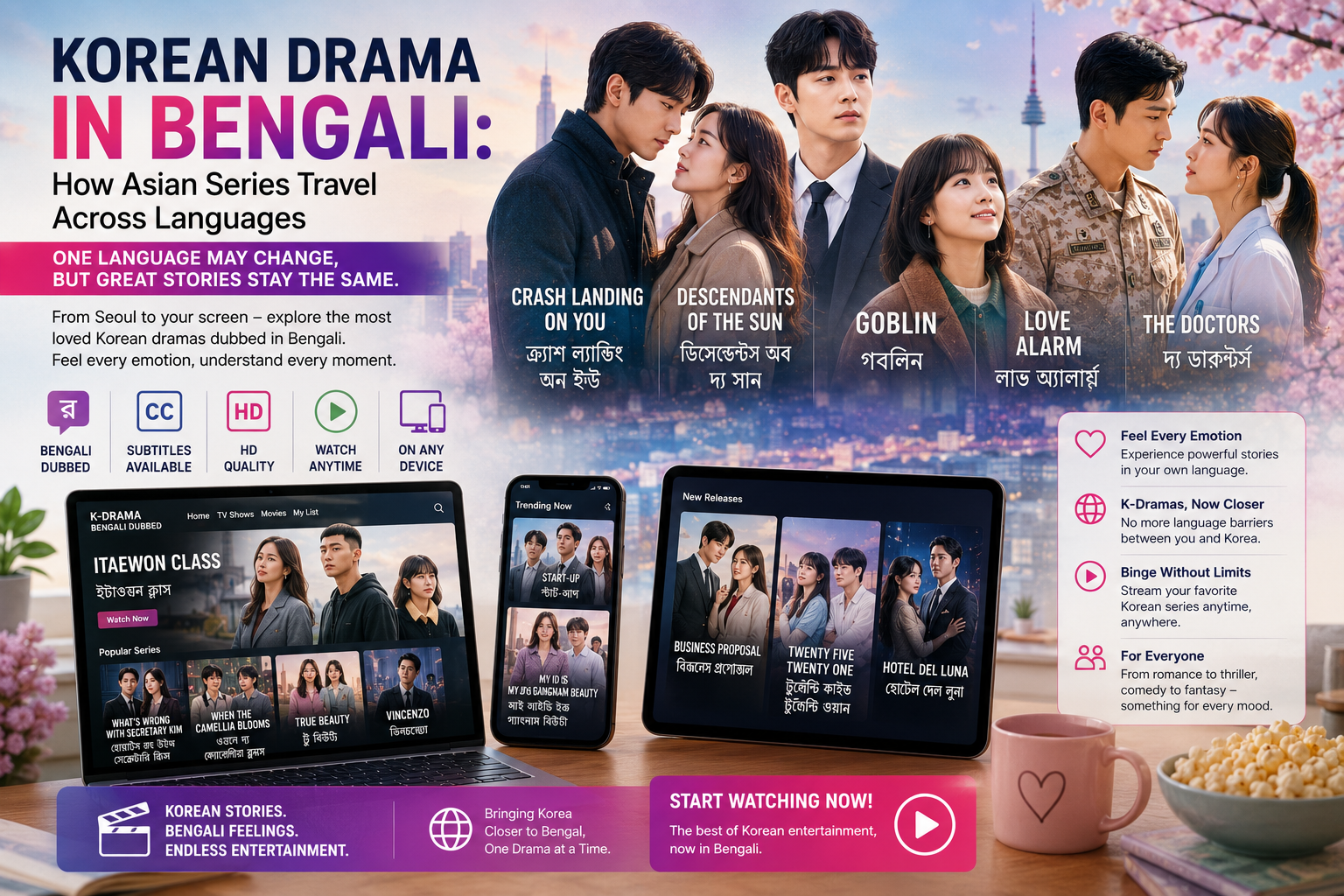
Korean drama has developed into a major international television phenomenon, reaching audiences far beyond South Korea through streaming, subtitling, dubbing, and increasingly sophisticated digital distribution. Its international popularity has also created demand for localized versions that allow viewers to experience Korean-language entertainment through their preferred languages. For Bengali-speaking audiences interested in কোরিয়ান ড্রামা বাংলা, this creates an interesting meeting point between Korean storytelling traditions and Bengali-language accessibility.
From Seoul to Bengali-Speaking Screens
The international expansion of Korean television has been closely connected to the growth of digital platforms. Instead of relying solely on television broadcasters to introduce Korean programming to foreign markets, streaming services can distribute series across borders while providing subtitles and localized audio.
Korean drama has become particularly prominent within this global entertainment movement. Netflix’s 2026 reporting continues to describe Korean content as an important part of its international offering, with Korean series regularly appearing among the platform’s most-watched non-English programming.
For Bengali-speaking viewers, localization adds another layer of accessibility. Bengali subtitles or dubbing can make Korean entertainment easier to follow for audiences who are comfortable consuming television in Bengali but may not understand Korean or prefer not to rely entirely on English subtitles.
Why Korean Drama Works Across Cultural Boundaries
Korean drama has achieved international popularity partly because its emotional and social themes can remain understandable even when the original cultural setting is unfamiliar. Relationships, family dynamics, professional ambitions, friendship, personal challenges, and everyday social experiences can provide points of connection for audiences in very different countries.
At the same time, Korean productions retain cultural characteristics that make them distinctive. Language, social etiquette, urban environments, fashion, food, music, and everyday routines introduce international viewers to aspects of contemporary Korean life without requiring the content to abandon its original identity.
For Bengali audiences, this combination can be particularly engaging. Localization provides linguistic familiarity while the Korean setting, visual style, and cultural details remain visible. The result is not a replacement of one culture with another but a form of cross-cultural entertainment in which accessibility and cultural difference coexist.
The Expanding Range of Korean Series
Korean drama is often associated with romance, but the wider television landscape is considerably more diverse. International streaming catalogs now organize Korean series across genres including drama, thriller, crime, mystery, comedy, action, fantasy, historical entertainment, and other formats.
This variety has become increasingly important as Korean content reaches larger international audiences. A viewer may discover Korean television through one familiar genre and then explore entirely different categories within the same catalog.
For Bengali-speaking viewers, this makes a well-organized digital interface particularly valuable. Clear genre shelves and intuitive navigation can reduce the distance between curiosity and discovery. Instead of requiring detailed knowledge of Korean television, the catalog can provide a simple starting point based on genre or viewing preference.
The growing scale of Korean entertainment also makes digital organization more important. As international catalogs expand, audiences need ways to distinguish newer additions from established series and to move between categories without navigating complicated menus.
Bengali Localization Changes the Viewing Experience
Language localization is more than a technical translation exercise. Subtitles allow viewers to retain the original Korean dialogue while understanding its meaning in Bengali, whereas dubbing can create a more immediate viewing experience by presenting dialogue directly in the viewer’s preferred language.
Both approaches have different advantages. Subtitles preserve the original vocal performances and linguistic character, while Bengali dubbing can be more accessible for viewers who prefer to concentrate entirely on the visual presentation. The appropriate format depends on the audience and the type of viewing experience they prefer.
The availability of localized Korean entertainment also reflects a broader trend in international streaming. Netflix, for example, has invested heavily in multilingual subtitles and dubbing as part of its strategy for making Korean and other non-English content accessible around the world. Its 2026 reporting highlights the continued international performance of Korean titles.
For Bengali-speaking viewers, this wider localization ecosystem makes Korean television feel less geographically distant. The content remains Korean, but the language of access becomes more familiar.
From Fixed Television Schedules to Flexible Drama Viewing
Traditional television requires audiences to follow a schedule established by a broadcaster. Korean drama originally reached many international viewers through television channels that determined when episodes would be available. Streaming has fundamentally changed this pattern.
Digital catalogs allow audiences to discover series when they have time rather than waiting for a particular broadcast. This is particularly useful for episodic entertainment because viewers may want to watch at different speeds depending on their schedules.
Students can watch during free periods, professionals can return to a series after work, and families can choose their own viewing times. The flexibility of online access means that Korean drama can fit into modern routines rather than requiring audiences to reorganize their routines around television programming.
A frictionless interface makes the process even more convenient. On Moviewala, viewers can browse the available entertainment, select a title directly from the shelf, and move toward playback without a mandatory registration wall. The absence of annoying pop-ups also keeps the experience focused on discovering content.
A Digital Catalog for Cross-Cultural Discovery
Korean drama is particularly well suited to digital discovery because international audiences often encounter it through recommendations, genre browsing, social discussion, or curated collections rather than traditional local television programming.
A strong catalog can support this discovery process by presenting Korean entertainment in an organized way. Viewers may begin with a genre, browse a collection, and gradually identify productions that match their preferences. This is more flexible than relying on a television schedule because the audience controls the direction of discovery.
For Bengali-speaking users, the interface itself can also play an important role. Bengali-language navigation and metadata can reduce friction and make Korean entertainment easier to explore even for viewers who have never previously followed Korean television.
The broader principle is simple: localization should extend beyond dialogue. The entire discovery environment can become more accessible when categories, navigation, and presentation are designed with the viewer’s language in mind.
Korean Drama on Smart TVs, Laptops and Phones
The international streaming audience is increasingly device-independent. Korean series can be watched on Smart TVs for a traditional home entertainment experience, while laptops, tablets, and smartphones provide greater flexibility.
This matters for Bengali-speaking audiences living in different regions and following different routines. A viewer may use a television at home, a laptop during the day, or a smartphone when traveling. A digital catalog that adapts across these screens makes Korean drama easier to integrate into everyday life.
Responsive navigation is essential because the same catalog needs to remain readable on large and small displays. Content shelves, search functions, language options, and playback controls should remain intuitive regardless of the device.
The best experience keeps the technology quiet. The viewer should be able to discover a Korean series, choose the preferred language format where available, and begin watching without unnecessary technical obstacles.
The Infrastructure Behind International Playback
Delivering Korean drama to Bengali-speaking audiences requires the same sophisticated digital infrastructure that supports other forms of international streaming. Cloud networks, content delivery systems, efficient video compression, and adaptive playback technologies work together to transmit audiovisual content across different geographic regions and connection speeds.
Localization introduces additional data requirements because a single production may have multiple subtitle files, dubbed audio tracks, metadata versions, and regional presentation formats. Efficient platform architecture needs to manage these components while keeping the visible interface simple.
Adaptive streaming can respond to changing network conditions, while distributed content delivery can reduce delays for geographically distant viewers. Efficient compression helps balance picture quality with bandwidth requirements, supporting stable playback across a variety of devices.
The viewer does not need to see this technical complexity. A well-functioning service allows the infrastructure to remain in the background while the Korean series itself occupies the foreground.
Why Korean Drama Has Become a Global Entertainment Category
The international rise of Korean drama is part of a larger shift in the way audiences consume non-English entertainment. Viewers increasingly explore content from countries they might never have encountered through traditional television. Korean cinema, drama, music, and other cultural exports have benefited from this growing international curiosity.
Digital platforms have accelerated the process by reducing distribution barriers. A series can become visible to audiences in multiple countries almost simultaneously, while subtitles and dubbing make the content approachable to people who do not understand the original language.
For Bengali-speaking viewers, Korean drama represents an especially interesting form of cross-cultural entertainment because localization creates a direct linguistic bridge. The audience can experience Korean production styles and cultural environments without having to rely exclusively on English-language access.
This creates a viewing experience that combines familiarity and discovery: the language can be Bengali, while the cultural setting remains distinctly Korean.
The Next Stage of Korean Drama in Bengali
The future of Korean drama for Bengali-speaking audiences will likely involve broader catalogs, more sophisticated dubbing and subtitle technologies, improved multilingual interfaces, and increasingly personalized discovery. As international streaming continues expanding, language localization will become an even more important part of how audiences encounter entertainment from other countries.
Faster connectivity and improved video delivery will also support more consistent playback across devices and regions. At the same time, better catalog organization can help viewers navigate an expanding selection without turning discovery into a complicated process.
The essential experience can remain simple. Open the Moviewala Bengali catalog, explore the Korean drama selection, choose a title from the shelf, and press play. With high-quality playback, direct access, no registration wall, and no distracting pop-ups, the digital environment can provide a comfortable bridge between Korean television and Bengali-speaking audiences.